PAIN POINT PULSE
“What’s easy for some people is Sisyphean to me.”
That’s a person with ADHD talking about their life experience. It’s the kind of language your audience uses when nobody’s selling to them. The kind your messaging probably isn’t using yet.
The person who eventually books an ADHD coach doesn’t search for “executive function support.” They post things like “I’ve tried setting an alarm to clean everyday for thirty minutes but that doesn’t work because I just ignore the alarm,” or “Entire days would disappear and I couldn’t explain where they went.”
Pain Point Pulse pulls the actual sentences your audience is writing, on Reddit, when they don’t think anyone is watching, and gives them back to you in a structured report. Use them in your next post, email, or landing page. Watch what happens when the writing finally sounds like it came from inside their head.
You’ve already tried the obvious things
You’ve asked ChatGPT and got something that sounded plausible and might be invented from nothing.
You’ve browsed Reddit for an hour and come back with three anecdotes and a headache.
You’ve run a survey and waited three weeks for twelve answers, none of which sounded like the person you met at the workshop in March.
None of it gets you closer to the actual sentences they use when no one is asking. That’s the gap. Pain Point Pulse is the bridge.
What you get when you buy a report
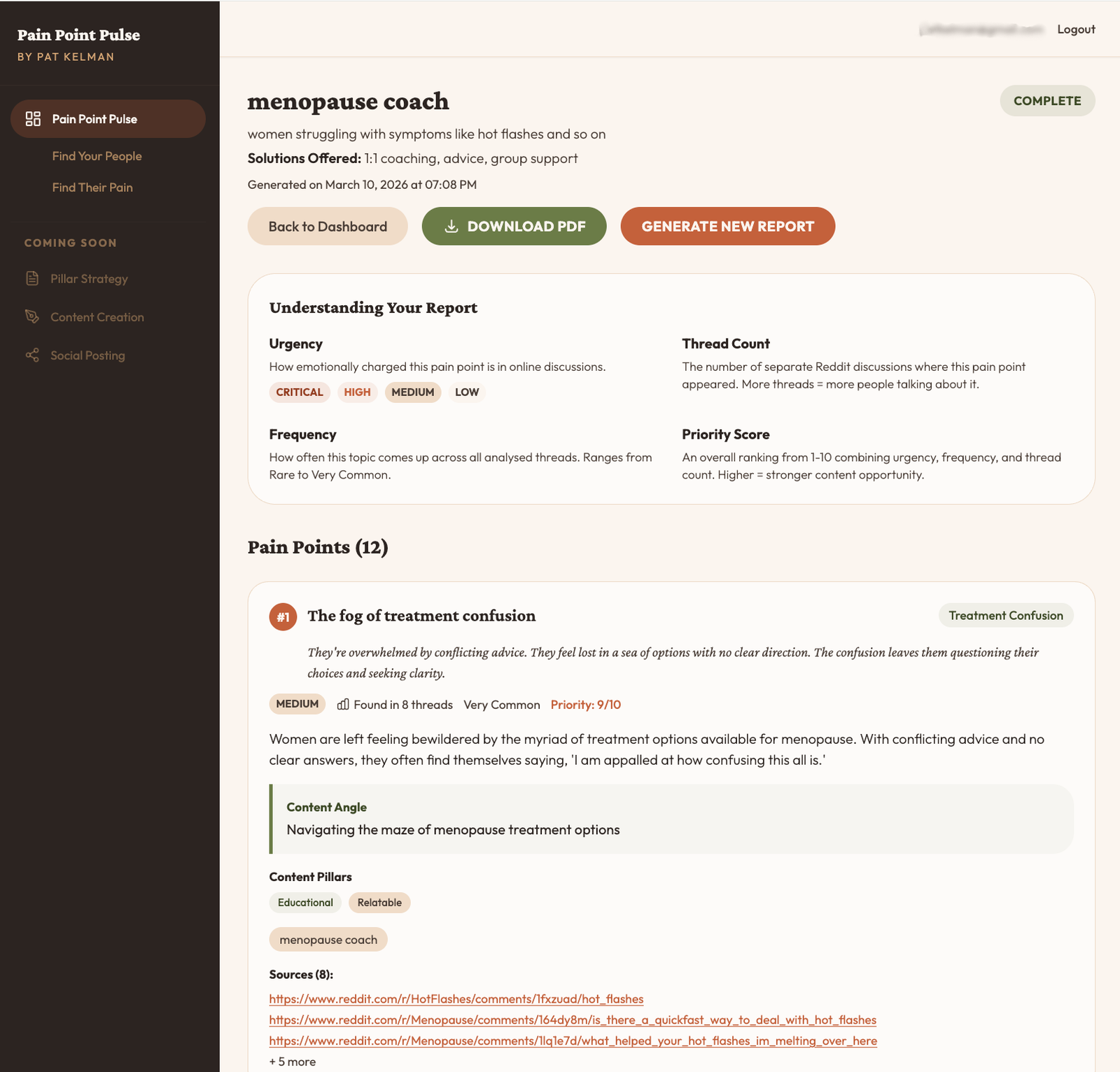
You give the system your business and the audience you want to reach. Fifteen minutes later, you get one report with:
- Five to eight clustered pain themes, ranked by how often they come up and how emotionally charged each one is.
- Thirty to sixty verbatim quotes, lifted from real Reddit threads in their actual words. American spellings, late-night typos, all of it. The mess is the signal.
- Source URLs to every thread, so you can go and read the original conversation yourself. Nothing is invented. Everything checks.
- Content angles pulled directly from the patterns. Not generic hooks. Specific lines that mirror what the audience is already saying.
- A sentiment map showing which themes are running hot and which are background noise.
- An executive summary covering customer analysis, recurring themes and how to stay in their head.
From this report, you can then generate specific content ideas based on each pain theme. You can generate new ideas as often as you want.
A single report gives you the material and insight to rewrite your landing page, create your next email sequence, and enough ideas to organise your social plan for the month. People come back to the same report for weeks.
Why this works
Most audience research describes what people say they want. The interesting material is what they say when they think nobody is listening. The first conversation is performed. The second one is real.
Pain Point Pulse runs in the second conversation.
I’m a film distributor. I needed this kind of audience research and analysis tool, and I couldn’t find one that did what I needed.
What this looks like
A divorce coach typed in their business. The audience said, “My anxiety was constant and it destroyed who I was before that.” Not “I felt anxious.” Destroyed.
A menopause coach typed in their business. The audience didn’t lead with hot flashes. They led with isolation. Five years of doctors saying, “you’re too young.”
A singing teacher looked for the things aspiring musical theatre performers might be worrying about. It wasn’t about “how do I get an agent” or “am I good enough.” It was much more specific: “casting directors see the same general choices all day long.” It was “The idea ‘you cannot afford to screw up’ is already placing the stakes way too high.”
How this compares
You could keep asking ChatGPT. It will give you confident, plausible audience patterns that come from nothing. There’s no source material underneath, so there’s no way to know if it’s right.
You could keep browsing Reddit. You’ll find real stories and genuine frustration. After an hour you’ll have a handful of anecdotes and no overview.
You could cluster the themes manually. It’s solid work. It also takes five to ten hours per niche, every time you change focus.
You could hire a positioning consultant. Equivalent output costs five hundred pounds and up, and takes weeks.
Pain Point Pulse does the same job in fifteen minutes, with sources you can verify on every line.
Who this is for
If you sell expertise (coaching, consulting, courses, services) and your messaging keeps landing close but not quite, this is where you start. People nod, people don’t buy. You suspect they describe the problem in different words to the ones you’re using. They probably do. This finds the words.
You don’t need to be a copywriter. You don’t need to know what “positioning” means. You don’t even have to know exactly who your audience is. If you can describe your business in one sentence, you can run this.
Who this isn’t for
If you don’t have a business yet (no service, no offer, no clients), the data has nowhere to go. Get your first paying client first. Then come back.
If you’re after “100 content ideas in 10 seconds,” this isn’t that. This is research. It’s the foundation that everything sits on after.
Pricing
£47
3 reports
Three full Pain Point Pulse generations. Real verbatim language, source links, pain themes, content angles, sentiment map. Most buyers don’t burn through three reports in their first month.
Need more later? Top up inside the app once your three are spent.
Not ready yet? Find Your People is free, and gives you six audience segments with the problems they’re probably wrestling with.
Stop guessing what your people sound like.
Three reports. Real audience language. Source links on every line. Go and listen.