The Shellac Layer
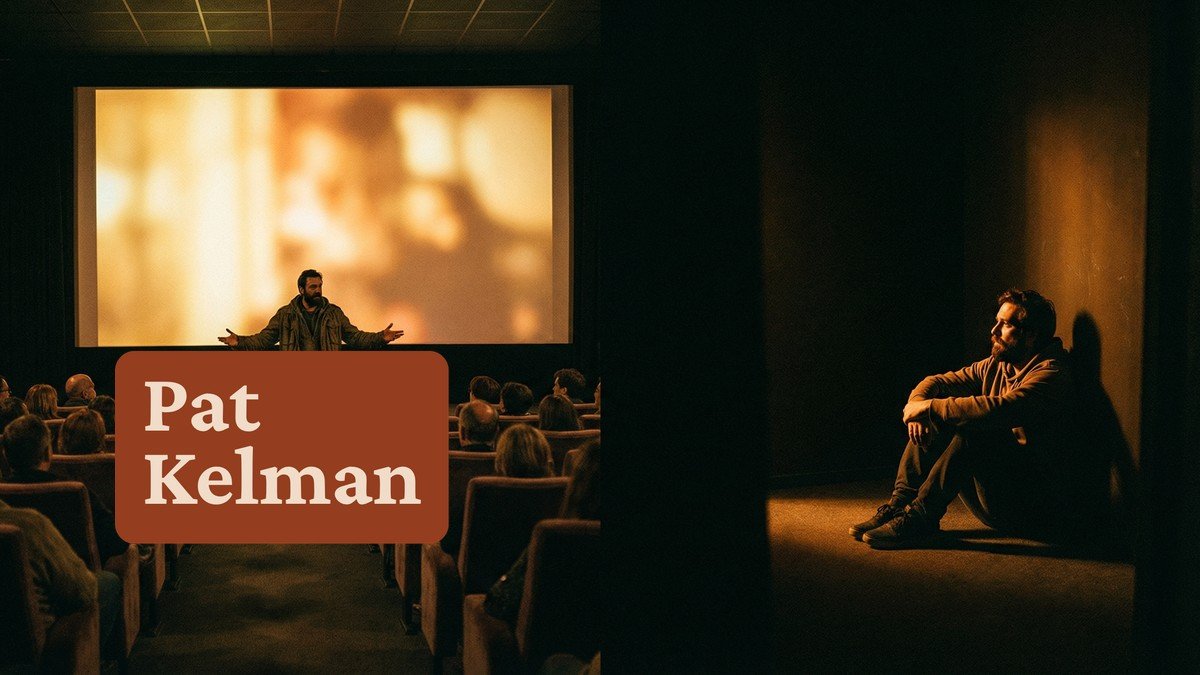
I remember standing at the front of a screening at the Plaza Cinema in Truro, maybe a hundred and twenty people in the room, and I’m doing the intro. The big version. Full Pat. Telling them about this film, what it meant to me, why I chose it, why they need to see it.
And I’m good at this bit.
That’s not arrogance, it’s the honest truth. I’ve been doing it since I was six years old.
And the whole time, there’s a voice underneath. A quieter one. Am I too much? Too loud? Too unfiltered? Am I making this about me when it should be about the film?
The performance works. People come up afterwards and tell me they loved it. But I’ve already moved to the back of the room, because that’s where I can breathe. That’s where I can actually watch the screen without anyone watching me.
I got diagnosed with ADHD at fifty-eight.
Everything that came before that had a frame at last. The careers I started and abandoned. The relationships I didn’t start, or complicated, or was totally unable to be present. The reputation for being too much on a Tuesday and too unreliable on a Wednesday. All of it suddenly had a name.
And with the name came the grief. Because you don’t get the years back. You don’t get the friendships back that you broke because you forgot (or were too scared) to call. You don’t get back the version of yourself that spent decades believing the problem was a character flaw, not a neurological fact.
What the diagnosis did was shine a light on a lifetime’s worth of shame and regret and (frankly) fear.
My particular form of masking is being great at public performance. I can hide behind a larger-than-life persona that is always just a thin shellac layer hiding my own deep-rooted insecurities and fears. Superficial confidence (arrogance?) disguising a seething morass of shame and self-criticism.
The RSD is the part nobody sees. Rejection Sensitive Dysphoria.
It’s not “being a bit sensitive.” It’s a genuine terror of being exposed. If people saw who I really was, not the film guy, not the performer, not the confident bloke with opinions about everything, they wouldn’t like me. Or worse. They’d be repulsed.
That fear shaped every career decision I’ve ever made, whether I knew it or not. Acting gave me somewhere to hide. I could be someone else, be brilliant as someone else, and nobody had to see me.
When Mike Leigh auditioned me for Topsy-Turvy, it was different. I trusted him completely. I was totally honest and raw in those auditions, willing to go wherever he needed me to go. His method strips everything back to what’s actually true in the actor, and for him, I’d have gone there.
It was not to be. But the experience made something clear that I’d always known: the hiding was the problem, not the being seen.
So I found another way.
If I couldn’t stand in the room and be myself, I could stand in the room and show you something. A film. A record. A tool. A story. The thing I’m holding up becomes the connection. Not me. The thing.
“Come and look at this” started as the only way I knew how to make friends.
Standing in a room not knowing how to do the social thing that seemed to come naturally to everyone else, I found a workaround that felt honest. If I could share something, if I could get someone to see what I saw, maybe there’d be a connection. Age six, sharing records. Hosting video nights every Saturday night during my A-Levels, a few mates, all-night sessions, me choosing what we watched.
The impulse was never aesthetic. It was survival.
There are, of course, advantages. Genuine ones, not consolation prizes. Unbridled creativity. An innate ability to see the big picture. An almost infinite capacity for empathy, honed by a lifetime of hyper-vigilance and the crushing need to be understood and heard.
Decades of immersion in art and story as a way of seeking some kind of connection and understanding.
That line between the fear and the advantages is where all the work lives. Pat’s Film Club, 606 Distribution, Pain Point Pulse, the teaching and training. Same gesture, every time. I find something that deserves attention and I can’t rest until you can see it too.
The shellac is still there. A lifetime of habitual hiding doesn’t come off in one go. But the process now is removing it, bit by bit. Showing who I really am. Not because vulnerability is fashionable. Because the whole point of what I do is finding the gap between what people say and what they actually mean.
It would be a bit rich to keep hiding my own.